

The spandrel beam is an important structural component in framed structures, playing a significant role in load transfer, torsional resistance, and exterior frame stability. This article explains what spandrel beams are and discusses the different structural aspects of spandrel beams used in steel and reinforced concrete buildings.
What is a Spandrel Beam?
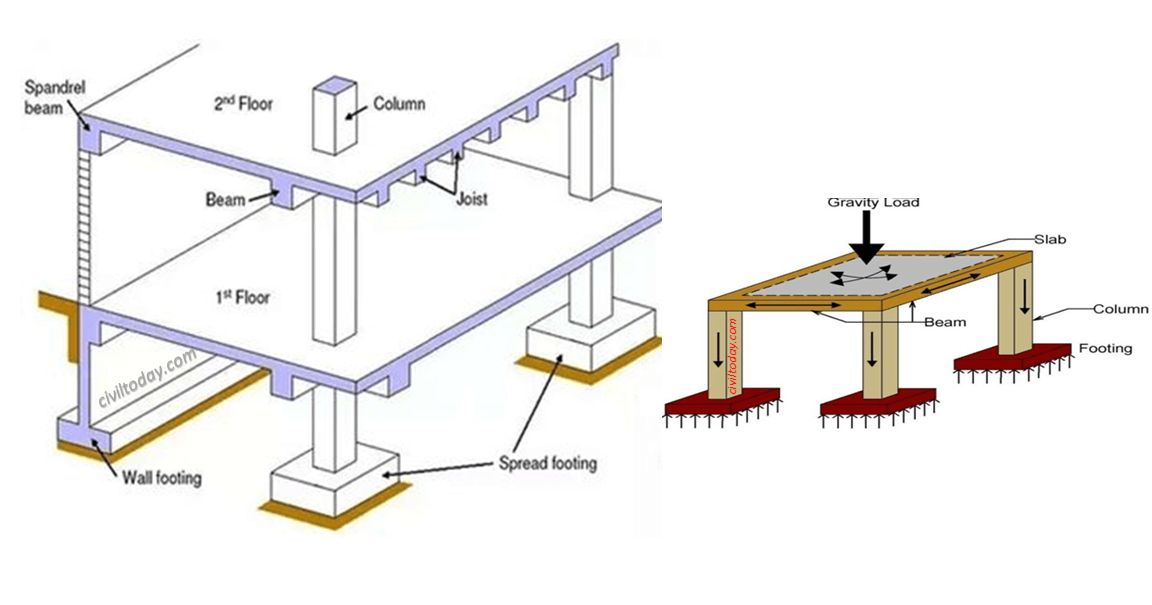
In steel or reinforced concrete structures, a spandrel beam is an exterior beam that runs horizontally along the perimeter of a building, connecting one column to another. It is also known as an edge beam.
Spandrel beams are generally provided at each floor level of multistorey buildings, where they:
- Support exterior masonry walls
- Carry slab edge loads
- Provide lateral stability to the outer frame
- Visually define floor levels in high-rise buildings
Load Distribution Mechanism
Spandrel beams transfer loads from slabs and external walls to the columns. The load path is:
Slab → Spandrel Beam → Column → Foundation
Unlike interior beams, spandrel beams are located at the edge of the slab. Because of this position, they experience:
- Bending moment due to slab load
- Shear force
- Significant torsion (due to eccentric slab loading)
- Axial compression from frame action
Torsion develops because the slab load is often applied eccentrically relative to the beam's centroidal axis. This eccentricity creates a twisting action, making torsional design a critical consideration.
For this reason, spandrel beams are designed as combined flexure–shear–torsion members.
Structural Features of Spandrel Beam
The structural behavior of a spandrel beam depends largely on its interaction with the floor beams and slabs connected to it.
- When connected to flanged floor beams (T-beams), torsional resistance improves.
- Its exterior location increases exposure to temperature variation and moisture.
- It requires additional torsional reinforcement, such as closed stirrups and longitudinal bars.
- It acts as a tie element, improving overall frame integrity.
According to ACI 318-19, torsion must be accounted for in design when the factored torsional moment exceeds the cracking torsion capacity of the concrete.
In seismic zones, proper detailing of longitudinal and transverse reinforcement enhances ductility and improves energy dissipation capacity.
Types of Spandrel Beam
Spandrel beams can be classified based on their structural configuration:
- Simply supported rectangular spandrel beam
- Simply supported I-section spandrel beam
- Continuous rectangular spandrel beam
- Continuous I-section spandrel beam
- Plate girder-type spandrel beam (used in steel structures)
In reinforced concrete buildings, rectangular and flanged sections are the most common.
Uses of Spandrel Beam
Spandrel beams are commonly used in:
- Multistorey buildings, at each floor level
- Supporting external walls and parapets
- Bridge structures, to support deck slabs
- Parking garages
- Coupled shear wall systems
In buildings, spandrel beams also support external openings, working together with lintels.
Advantages of Spandrel Beam
- Enhances the perimeter stiffness of framed structures.
- Improves the torsional resistance of the exterior frame.
- Supports façade and wall loads efficiently.
- Improves seismic performance when properly detailed.
- Acts as a tie beam connecting columns.
In wide beam–column connections, spandrel beams with adequate torsional reinforcement significantly improve joint behavior.
Disadvantages of Spandrel Beam
- Subjected to high torsional stress, requiring careful detailing.
- Exterior exposure increases the risk of reinforcement corrosion.
- More pronounced effects from thermal expansion and contraction.
- Higher reinforcement congestion at beam–column joints.
Improper detailing may lead to cracking, spalling, and long-term durability issues.
FAQs
What is the difference between a spandrel beam and a girder?
A girder is a primary beam that supports other beams. A spandrel beam, on the other hand, is typically an exterior beam located along the building's perimeter, and may or may not act as a primary beam depending on the structural configuration.
Key differences:
- A spandrel beam is located at the perimeter of the building.
- A girder may be located either internally or externally.
- Spandrel beams are more prone to torsion due to eccentric slab loading.
- Girders mainly resist bending and shear.
Functionally, spandrel beams are structural members in their own right, not merely decorative elements.
References
- ACI 318-19 – Building Code Requirements for Structural Concrete
- McGraw-Hill Dictionary of Scientific & Technical Terms
- Mogbo, N.C.I. (1968). Torsional Behavior of Spandrel Beams
- Behnam, H. et al. (2016). Behaviour of RC Spandrel Beam in Exterior Wide Beam-Column Connections