
 Civil Engineering
Engineering for Life
Civil Engineering
Engineering for Life
Civil Engineering Materials: A Full View
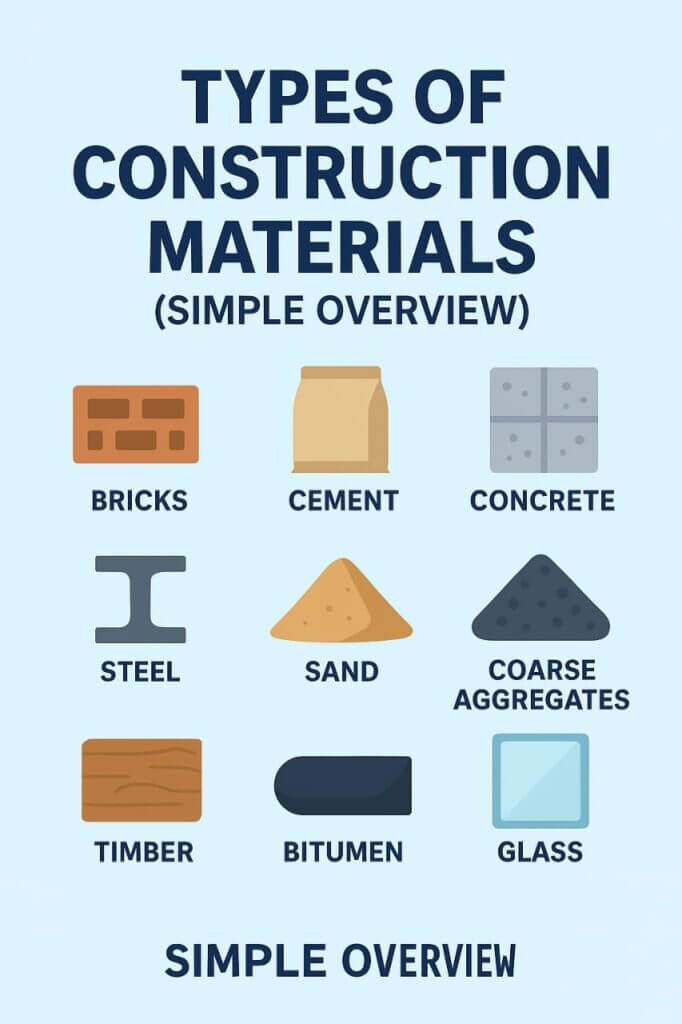
Civil engineering materials are the basic substances used for the construction of buildings, bridges, roads, dams, and other infrastructure works. The quality, strength, durability, and service life of a structure mainly depend on the type of materials used. Therefore, the proper selection of construction materials is one of the most important responsibilities of a civil engineer. Each material has its own properties, advantages, and limitations. Some materials provide strength, some provide binding, and others help in durability and protection. Knowledge of civil engineering materials is essential for design, construction, quality control, and maintenance work. In modern construction practice, materials are selected based on strength requirements, exposure conditions, cost, and availability. This article explains the commonly used civil engineering materials, their properties, and practical applications.
1. Cement
Cement is a finely powdered binding material widely used in civil engineering construction works. It is mainly used for the production of concrete and mortar. When cement is mixed with water, it forms a paste that gradually hardens due to hydration. Ordinary Portland Cement (OPC) is the most commonly used type in construction. Cement provides strength, durability, and resistance against weathering and environmental action.
Related Cement Articles on Civiltoday
- What is Cement?
- Types of Cement
- Cement Ingredients and Their Functions
- Physical and Chemical Properties of Cement
- Cement Manufacturing Process
- Uses of Cement
- Raw Materials of Cement
- Properties of Good Cement
- Field Tests of Cement
- Storage of Cement
- Fineness of Cement
- Cement Manufacturing Industries and Plants
- Specific Gravity of Cement
- Difference Between OPC and PPC
- Rapid Hardening Cement
- Uses of Rapid Hardening Cement
- Advantages and Disadvantages of Rapid Hardening Cement
- Portland Slag Cement (PSC)
- Cement Storage Godown or Warehouse Requirements
Related Clinker Articles
Related White Cement Articles
Related Refractory Cement Articles
- Refractory Cement: Composition, Installation, and Uses
- Advantages and Disadvantages of Refractory Cement
2. Aggregates
Aggregates are inert granular materials such as sand, gravel, and crushed stone used in construction works. They occupy about 60–75% of the total volume of concrete. Aggregates contribute to the strength, stability, and durability of concrete. They reduce shrinkage and help in making concrete economical. Based on particle size, aggregates are classified into fine aggregates and coarse aggregates.
Related Aggregate Articles on Civiltoday
- What is Aggregate?
- Density of Aggregate: Bulk Density and Relative Density
- Fine Aggregate: Definition, Types, and Uses
- Difference Between Fine and Coarse Aggregate
3. Concrete
Concrete is a composite construction material made of cement, aggregates, and water. It develops strength through hydration. Concrete has high compressive strength, good durability, and resistance to weathering. It can be moulded into any desired shape before hardening. Due to its versatility and availability, concrete is the most widely used construction material in civil engineering works.
Related Concrete Articles on Civiltoday
- What is Concrete?
- Composition of Concrete
- Uses of Concrete
- Types of Concrete
- Properties of Concrete
- Modulus of Elasticity of Concrete
- Advantages and Disadvantages of Concrete
- Density of Concrete
Prestressed Concrete
- What is Prestressed Concrete?
- Types of Prestressed Concrete
- Advantages and Disadvantages of Prestressed Concrete
- Applications of Prestressed Concrete
Workability of Concrete
- What is Workability of Concrete?
- Factors Affecting Workability of Concrete
- Slump Test of Concrete
- Types of Concrete Slump
- Advantages and Limitations of Slump Test
Precast Concrete
Other Concrete Topics
- Vacuum Concrete
- Cinder Block vs Concrete Block
- Advantages and Disadvantages of Reinforced Concrete
- Stamped Concrete
- Advantages and Disadvantages of Stamped Concrete
4. Steel
Steel is a strong and ductile construction material widely used in civil engineering works. It is mainly used as reinforcement in concrete to resist tensile stresses. Structural steel is also used directly in buildings, bridges, and industrial structures. Steel has high strength-to-weight ratio, good ductility, and excellent recyclability.
Related Steel Articles on Civiltoday
- What is Steel? Types of Steel
- 18 Different Uses of Steels
- Stainless Steel
- 10 Main Uses of Stainless Steel
- Carbon Steel
- Difference Between Screw and Bolt
- Difference Between Ferrous and Nonferrous Metals
5. Bricks
Bricks are masonry units made from clay and hardened by burning in kilns. They are commonly used for wall construction in buildings. Bricks are durable, fire-resistant, and easy to handle. Brick masonry provides good strength and thermal comfort.
Related Brick Articles on Civiltoday
- What is brick?
- Types of Bricks
- Composition of Bricks
- Characteristics of Good Bricks.
- Uses of brick.
- Compressive Strength of Brick
- Density of Brick
- Thermal Conductivity of Brick
- Advantages and Disadvantages of the Hoffmann kiln.
- What are Refractory or Fire Bricks? Types, Composition
- Properties of Good Refractory Bricks
- Uses of Refractory Bricks
- Lime Pitting
6. Timber
Timber is a natural construction material obtained from trees. It is light in weight and easy to cut, shape, and join. Timber is widely used in doors, windows, roofs, and formwork. Proper seasoning and preservative treatment are required to improve durability.
Related Timber Articles on Civiltoday
- What is Timber?
- Types of Timber
- Properties of Timber
- Defects in Timber | Defect Types Causes
- PDF Documents on Defects of Timber
- Uses of Timber
- Uses of Wood
- Seasoning of Timber - Reason - Methods - Benefits
- Softwood: Definition, Characteristics & Examples
- Uses of softwood
- Hardwood: Definition, Properties & Examples
- Types of Hardwood
- Softwood vs Hardwood
- MDF vs Plywood
- MDF vs HDF
- What is Plywood? Types of Plywood
- Properties of Plywood
- Uses of Plywood
- Plywood Manufacturing Process - Step by Step
- Advantages and Disadvantages of Plywood
- What is MDF wood? Types, Properties, Manufacture
- Uses of MDF
- Advantages & Disadvantages of MDF
- Precautions Required for Using MDF
- Is MDF Waterproof?
- How to Waterproof MDF
- Is MDF Fireproof?
- How to Paint MDF for a Smooth Finish
- What is Blockboard? - Properties, Types, Processing
- Uses of Blockboard
- Advantages and Disadvantages of Blockboard
7. Bitumen
Bitumen is a viscous and waterproof binding material obtained from petroleum. It is mainly used in road construction works. Bitumen provides flexibility, durability, and resistance to water penetration. It is widely used in asphalt pavements and surface dressing.
8. Stones
Stones are natural building materials obtained from rocks. They are strong, durable, and resistant to weathering. Stones are mainly used where high compressive strength is required. They are commonly used in foundations, retaining walls, and road works.
Conclusion
Civil engineering materials are the backbone of construction works. Proper understanding of their properties and uses ensures safe, durable, and economical structures. A civil engineer must select materials carefully based on design requirements, site conditions, and environmental exposure. Correct use of materials leads to sustainable and long-lasting infrastructure.
Disclaimer
Please note that the information in Civiltoday.com is designed to provide general information on the topics presented. The information provided should not be used as a substitute for professional services.
Following are our other sites for you:
Pages to follow